

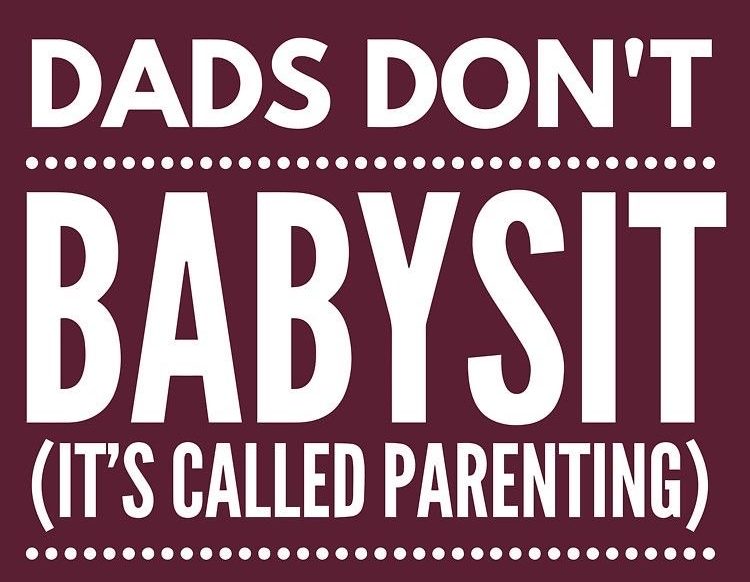
No one babysits their own child. It’s called parenting, and maybe you shouldn’t be one if it feels like such a chore.
There are too many comments and jokes about fathers “having to babysit their own kids,” but in what world does parenting become babysitting just because someone wants to do the bare minimum? Parenting shouldn’t be treated like a favor. It should simply be done.
“It’s extremely insensitive and disrespectful. No parent babysits their kid. It’s too normalized for dads to treat being a parent as something secondary and not something they chose. You don’t babysit your children. You do your job as a parent,” Kyndall Rios said.
The joke usually targets fathers and is rarely used about mothers. You almost never hear someone say a mother is “babysitting her own child,” because she is expected to do the hard work and take full responsibility. Mothers don’t get breaks from being a mom, while fathers are often portrayed as if they do.
Fathers shouldn’t act like parenting is a part-time job instead of their responsibility.
“I definitely don’t think it would still be a laughing matter if it were an Uno reverse situation,” Kyla Channita said. “Parenting responsibilities almost always are placed on the mother, so I feel in this situation she would be given side-eyes and judged for not being more attentive to her child.”
Channita said she has seen the imbalance firsthand.
“From my own experience, when I’ve witnessed men taking care of their child, they do the absolute bare minimum until mom comes in to save the day so dad can continue hanging out. Weaponized incompetence is not always the case, but it happens often,” she said.
Perfection is a standard mothers often feel forced to meet, because society rarely shames a father for simply showing up. A mother is expected to be grateful that he is involved at all.
The expectations are unequal. A mom ordering takeout might be labeled “lazy” or “unfit,” but a father doing the same thing may be called the “cool” or “fun” parent. The imbalance undermines the work mothers do. Why does she have to work so hard to be considered a good parent, while he takes a casual walk in the park and is praised as a great dad?
“Yes. In the professional world, when women become moms, they often have their hours and pay decreased because they are expected to be the primary caretaker of their children,” Michaela Quaas said. “I have seen many videos on social media where fathers who are looking after their children refer to it as ‘babysitting,’ and there are usually a lot of comments complimenting those dads on how involved they are in the kids’ lives.”
Quaas said the language is rarely used for mothers.
“I can’t think of one example of a woman taking care of her own kids and that being called ‘babysitting,’” she said. “Also, in social settings, when moms go out without their kids, people aren’t afraid to ask where their kids are and who is looking after them. Dads do not get asked the same question because people assume the mom is taking care of them.”
In a 2024 study, mothers were found to handle 71 percent of household tasks that require mental effort, about 60 percent more than fathers. Moms also take on 79 percent of cleaning and child care tasks, more than twice as much as dads, often while balancing jobs outside the home. Even at work, many mothers say they are still mentally managing their children’s needs. Too often, the mental load of parenting falls on the mother.
“To ease the imbalance of the mental load on mothers in the home, we need a cultural shift that promotes authenticity over perfection,” Julie Butler said. “Social media should be used to build a genuine community, not as a platform for comparison where only polished parenting moments are shared.”
Butler said changing the narrative could help create balance.
“We must dismantle the unrealistic social pressures placed on mothers to appear flawless, never needing help or rest,” she said. “If more moms begin showing the unfiltered realities of parenting, it can foster empathy, reduce judgment and help mothers feel seen and supported. Recognizing that parenting is a shared responsibility, not one that should fall solely on mothers, is key to creating real balance.”