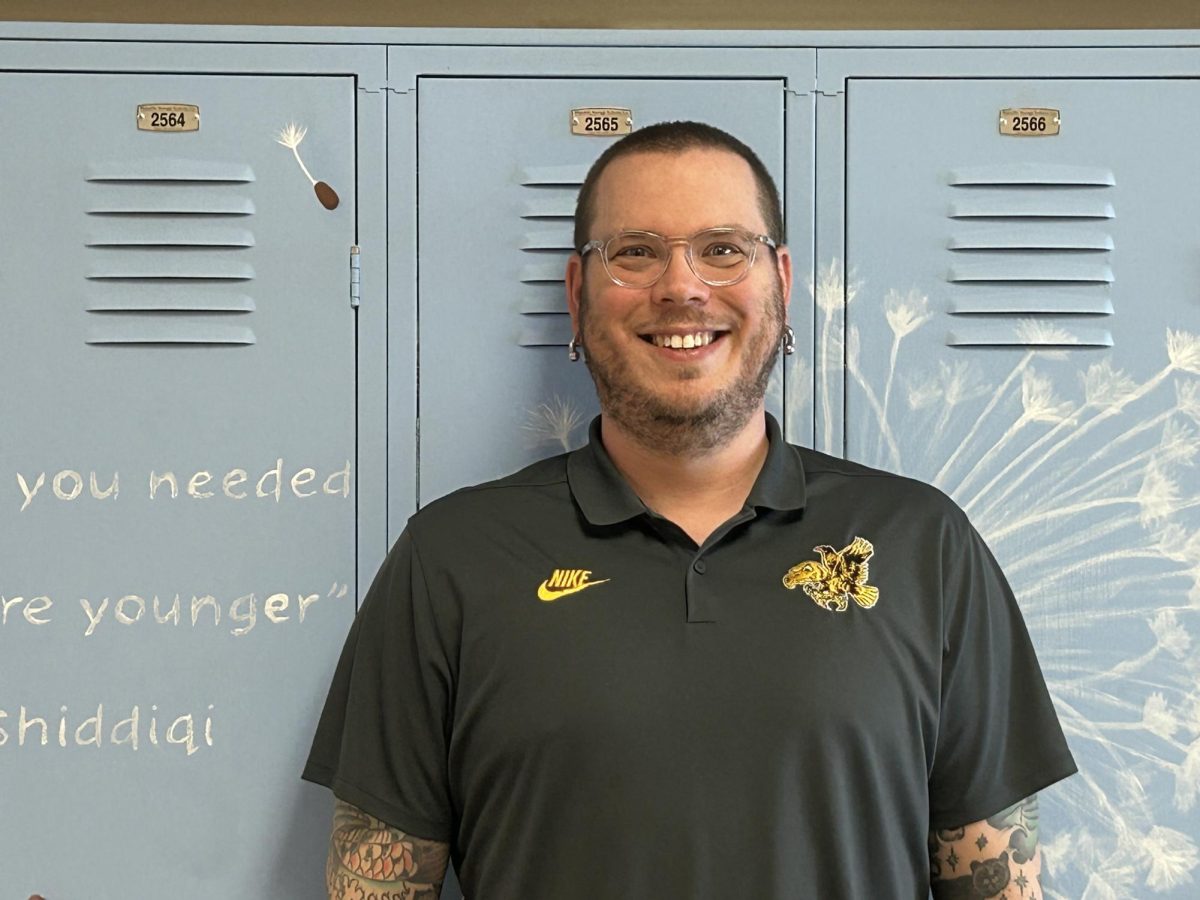

If you listen long enough to Chris Perez, you’ll notice a little bit of disdain for artificial intelligence.
AI has made its way into many industries, taking away the complicated tasks that can be difficult for humans to perform, such as humans manufacturing things. While it does make our businesses function faster, is it really the answer to a problem, or are we just becoming lazy?
“I studied art for two years,” Perez said. “Around the time I started, was when AI was becoming public. Throughout my two years, AI completely changed. The development was unlike anything I had ever seen. The advancement started taking over videos, imagery, it’s taking over the creative side of businesses.”
Businesses are becoming more reliant on the new generation of technology to help propel their company instead of people. Even if AI helps further businesses, what use is it when it comes at the harm of the people? It affects the economy now, but as it develops, it will only get worse.
“It can make jobs easier and more efficient, but it can also be abused and used for bad purposes,” math instructor Aaron McBride said.
It is projected to take over in manufacturing companies and in finance, the takeover of the job market.
According to NU.edu, 79% of employed women in the U.S. work in jobs at high risk of automation, compared to 58% of men.
Although the gender disparity in jobs that have a risk of automation is shocking, we cannot predict the future; however, I can guarantee you that it will only get worse. It can benefit us greatly; however, just like everything else, there are two sides to one coin.
According to Forrester.com, 6.1% of all jobs, or 10.4 million jobs, are projected to be lost because of AI by 2030.
“We don’t know what the future holds for us, but it is our responsibility to be aware and prepare ourselves for what’s to come,” special education instructor Francis Finn said. “It can contribute in a big way, but it also can destroy us. Artificial intelligence gives us easy access to knowledge that we didn’t have before; however, it needs to be controlled.”
Is AI getting rid of creativity, or does it present new opportunities for creativity to expand?
According to instructor Nathan Hill, cheating on assignments isn’t a new phenomenon.
In school, we think of ChatGPT or AI affecting English or other classes where writing essays is required. Classes you wouldn’t expect to be affected by AI are completely changing the way teachers teach their classes.
“In all the years I’ve been teaching, which is over 20 years now, every year students will cheat on their math homework,” Hill said. “It used to be a harder thing to do. You would have to find somebody who knows how to do it and convince them to let you cheat. It was hard to cheat on your homework. AI has made it really easy to cheat on your homework.”
Some students see AI as a positive asset to student life in high school. The intention is what matters. We control the information we receive.
“I really don’t see AI as a problem. It’s the people behind the screen that have all the power to choose what to do with it,” Brady Mockmuduv said. “AI can be used as a valuable resource as long as we use it right. AI can expand creativity beyond what we can imagine. The problem is we copy off it instead of using it to expand creativity.”
AI has even seeped into the music industry with the top-rated Spotify artist who has all AI-generated music. Students are outraged by this and afraid of what the future is going to turn into.
“I feel like art is dying because a lot of people use AI to generate art,” Jai-Lani Fagnon said.
Some students who use AI admit that it’s wrong; however, they can’t stop using it. AI is so convenient in everyday life that it is a regular tool students use every day.
“Students probably wouldn’t use AI as much if it didn’t give you the answer,” Gabby Winther said. “The problem with it is it gives you the answer instead of explaining things to get you there.”
Is the desire for an education gone because of how easy we’ve made it?
“I’m worried about the future of education with the development of AI. If we make it do everything and answer every question, is there really a reason for education without critical thinking? Finn said.
Is the Evolution of AI Becoming a Problem?
English teacher Derek Adams is quite confident that the genie is already out of the bottle.
With artificial intelligence consuming classrooms around the country, teachers are struggling AI-generated work.
“AI is integrated into every single thing that we do. I don’t think we can turn it off even if we wanted to,” Adams said.
With AI becoming normalized by society, it has become inescapable. While there are some advantages, one big drawback teachers can’t seem to get over is the idea of creating essays in seconds.
“There are lots of benefits to AI in schools, but it becomes a problem when students use it as a crutch,” Alice Baker said. Students rely and depend on AI to get them through school, but it becomes a problem when students use AI totally for all of their assignments, which affects students’ ability to solve real-world problems independently.”
This generation has knowledge at its fingertips. We can research anything with the touch of a button; however, instead of using it to further our knowledge, we use it as a copy-and-paste tool.
“I believe that when we make things too easy for people at any age it can interfere with our desire to challenge ourselves by using our critical thinking skills,” Baker said.
AI is now an instrumental part of society. There is no denying that most of us depend on AI every day. There are pros and cons to everything. AI, just like anything else, is a tool that some of us abuse. There is no going back.
“We’ve gotten to a point in society where nearly everything we do is done with a robot,” Francis Finn said. “There is no reversing damage that has already been done, so as much as it pains me to say, we need to look toward the future and adapt.”